Harris County, Texas
Fiscal Year 2027 Budget Investigation
The FY27 budget compared with the FY26 budget and FY26 actual spending; the $181 million shortfall and the 7.6% tax-rate increase; what pay increases and spending were approved, and where they are disclosed to the public.
Prepared: September 21, 2026, four days after Commissioners Court adopted the FY27 budget and 2026 tax rates (Sept. 17, 2026). Revised: September 23, 2026 (revision 2) after an independent review of the first edition; the corrections are listed in Appendix B and in AUDIT_SUMMARY.md, and the review itself is saved in independent_review_2026-09-23/. Basis: Harris County budget books (Volumes I and II, all versions), County Auditor monthly financial reports and the FY2025 audited financial report, the Auditor's revenue estimates, the Tax Office's Form 50-856 tax-rate worksheets, Commissioners Court agendas, the County's Five-Year Financial Plan, the Baker Institute's July 2026 review, and 50+ contemporaneous news reports. Every figure is traceable to a document listed in REFERENCES.md; source files are saved alongside this report.
Fiscal years: FY27 runs Oct. 1, 2026 to Sept. 30, 2027 and is funded by tax year 2026 rates. FY26 runs Oct. 1, 2025 to Sept. 30, 2026. "General Fund" is the county's main operating fund (about 55% of the $5B operating budget); Flood Control, Harris Health, the Port and the Toll Road are budgeted separately. This is an independent analysis and is not affiliated with Harris County.
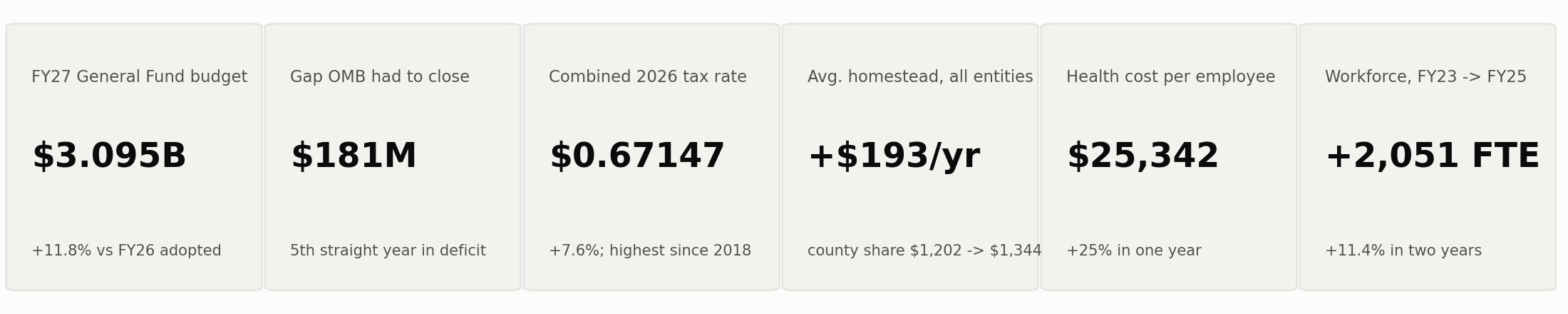
Sources for the tiles: FY27 Budget Vol. I v3 (Appendix A, p. 15, p. 17, p. 41); Commissioners Court 9/17/2026 rates; Houston Public Media 9/17/2026; Auditor ACFR FY2025 Table 19.
1. Summary of findings
Is the FY27 budget higher? Yes, by every measure. General Fund departmental appropriations are $3,095.4M, up $326.0M (+11.8%) from the $2,769.4M adopted for FY26, up 17.6% from FY25 actual spending of $2,632.5M, and up 11.7% from the Auditor's projection of FY26 actual spending ($2,772M). Counting "working capital", total General Fund appropriation authority rises from $3,114.5M to $3,351.4M (+7.6%). Over the prior decade General Fund spending grew about 6% a year (7% over the last five); FY27's +11.8% follows FY25's +11.1% budget-to-budget increase, and the county's own Five-Year Financial Plan calls growth at this pace unsustainable.
What caused the $181M shortfall? The county has projected a deficit at budget time five years running: $39M (FY24), $129M (FY25), $130M rising to $275M after the law-enforcement pay-parity vote (FY26), and $129M rising to $181M after a July 2026 healthcare re-estimate (FY27). The cause is structural: recurring costs grow 6-7% a year while property-tax revenue from existing property is capped at 3.5% by state law (SB 2, 2019) and taxable value grew only 0.8% this year. On top of that base, FY27 carries specific commitments made in 2025-26: year two of law-enforcement pay parity with HPD (adopted May 22, 2025 without a funding source; $44.6M of FY27 department increases, about $76M with supervisors and staffing), employee healthcare (+$100M county contribution; +25% per employee; no employee premium increase), the first full year of the pay-equity study ($30M of new compensation-study funding; the $60.8M distributed to department lines is offset by an equal reduction of the central pool, which keeps a $21.4M balance), restoration of $69.3M of one-time savings used to balance FY26 (a $25M hiring freeze and $44M of special-fund transfers), $30.8M to fund vacant law-enforcement positions, $30M of TIRZ payments and state mandates, and roughly $14M of programs that had been paid with expiring federal ARPA money. Indigent-defense costs ($142M in FY24, $184M projected FY26) and jail outsourcing remain the largest cost drivers of the past several years.
How was the gap closed? Mostly with the tax increase and one-time money, not with recurring savings. In OMB's May 2026 scenarios the maximum tax rate allowed without an election yields about $128M more revenue than the no-new-revenue rate ($2,927M vs $2,799M); that assumption is already inside the $181M gap. Of the $181M gap, $98.9M (55%) is covered by non-recurring money: $82.9M of one-time revenues (building and land sales $41.0M, a 2022-2026 overhead catch-up billing to the Toll Road Authority $19.1M, special-fund interest transfers $12.0M, ARPA interest $8.8M, prior-year billing $2.0M) plus a $16.0M drawdown of the FY25 surplus. New recurring fees and cost recovery add $19.7M; the rest is revenue re-estimates and modest spending trims (a lower pension contribution rate saves $10.6M; jail outsourcing net $3M; hiring-freeze savings $5M). No layoffs. The budget book itself says a "replacement funding source will be needed in subsequent years" for the one-time items. The 55% is the ratio of OMB's own one-time items to the planning gap; OMB publishes no item-by-item bridge, so the residual figures in Figure 4 are arithmetic, not a county reconciliation.
The tax increase. The county's total rate (M&O $0.36396 plus debt service $0.05354) rises from $0.38096 to $0.41750 per $100 (+9.6%), which the Tax Office worksheet shows is exactly the voter-approval maximum (line 69). Flood Control ($0.05266) and the Port ($0.00603) also adopted their maximums; Harris Health adopted $0.19528, below its $0.23917 maximum. The combined rate goes from $0.62413 to $0.67147 (+7.6%), the highest in the ten-year series the county publishes (2017-2026). The statutory notice says budgeted county property-tax revenue rises $210.7M (+8.1%), of which $54.4M comes from new construction and about $42M passes through to reinvestment zones; the M&O and debt-service tables in the same posting imply a $246.5M increase, a $35.8M difference the document does not explain. For the average homestead ($402,489), the county portion of the bill rises from $1,202 to $1,344 (+11.8%); all four entities together add about $193 a year.
FY26 actual spending. Through June 30, 2026 (nine months) the General Fund had spent $2,048.3M, 5.9% more than the same period of FY25, with a further $667.0M encumbered. The Auditor projects full-year FY26 spending of $2,772.2M, essentially 100% of the adopted $2,769.4M, against projected revenue of $2,754.7M. Salaries and benefits are running 13.45% above the prior year, the visible footprint of the pay-parity and pay-equity decisions. FY25 closed with spending of $2,632.5M (98.6% of budget) and a $54M cash surplus.
Are pay increases and spending hidden? Not concealed: every item in this report appears in a public document. But the full cost is dispersed in ways that make it hard for a resident to assemble, and several of the largest commitments were made in votes separate from the budget. Specifically: (1) two different "budget" totals circulate ($3.095B in press releases, $3.351B in the statutory tax notice); (2) $256M of "working capital" sits outside the departmental total, and $93.4M of it is pre-allocated to the County Judge and the four commissioners as a "75% rollover" that does not appear in their line-item budgets (Precinct 1: $47.7M line item, $81.4M total authority); (3) a $221M "General Administration" catch-all holds the pay-equity pool ($21.4M), TIRZ payments ($91.3M), litigation ($18M), jail outsourcing ($39.8M) and negative offsets; (4) law-enforcement parity (May 2025) and the $305,000 elected-official salaries (Aug. 6, 2026) were approved as stand-alone agenda items; (5) the county funds $90.8M of the "contract patrol" program presented as customer-funded ($39.8M of it because contract rates lag officer cost, $51.0M for contracts covering less than an officer's full time); (6) the Volume II position tables carry a disclaimer that they "should not be used to determine available and budgeted positions"; and (7) the county publishes no itemized reconciliation of how the $181M gap was closed. The Baker Institute's July 2026 review reached the same conclusions about working capital, unallocated funds and shared-service costs. Details in Section 7.
On the "$186 million" figure. Official documents use $129M (May forecast), $178M (Aug. 14 briefing), and $181M (Aug. 17 proposed budget and the adopted book). Judge Hidalgo's newsletter uses $189M; most coverage says "more than $180M". No county document uses $186M; the figure is within the range of numbers that circulated in August and September.