6B. Employee health benefits: who pays, and what the FY27 increase is
Short answer. Single coverage on the county's standard plans is premium-free: an employee on the Base PPO or the KelseyCare ACO pays $0 and the county pays the full internal rate of $433.03 per pay period ($11,259 a year). Employees do pay for the richer Plus PPO ($36.35 per pay period, $945 a year), for dependents ($109 to $291 per pay period, $2,835 to $7,560 a year, roughly 20% of the cost of family coverage), and at the point of care (Base plan deductible $600 per person, copays of $20 to $50, $300 for an emergency visit, out-of-pocket maximum $7,350). In aggregate the county's own chart shows employees and retirees paying about $71M (15%) of plan contributions in 2026 against $397M (85%) from the county, a share that has risen every year from 80% in 2020; OMB notes the "industry standard is an 80/20 cost share." Most retirees' own coverage is also free once they are Medicare-eligible. So the claim that county employees pay nothing is true for single coverage on the standard plan and for most retirees, and false for dependents, the Plus plan and cost-sharing.
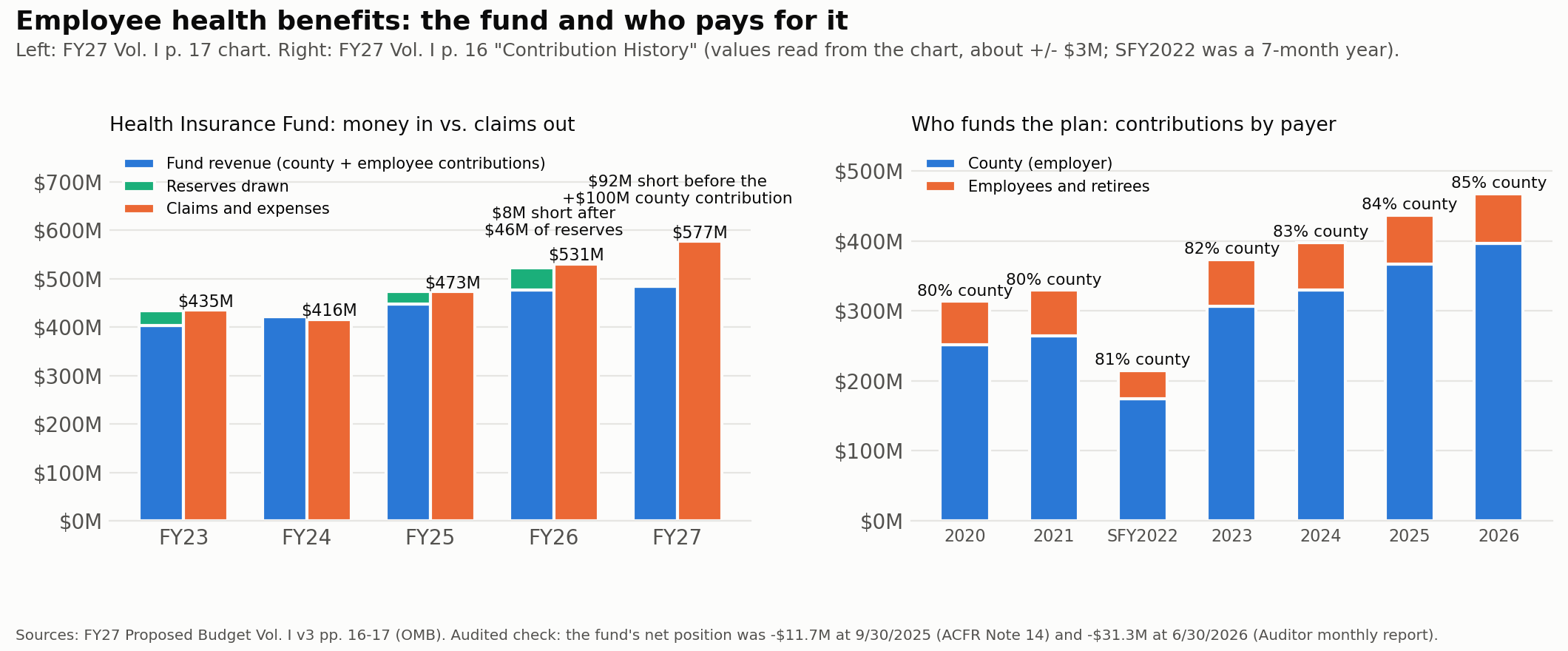
Figure 10. The Health Insurance Fund has drawn $102M of reserves since FY23 and still fell short; FY27 is balanced only by a $100M increase in the county contribution.
| Coverage tier (plan year 2026; unchanged for 2027) | Base PPO / KelseyCare: employee pays | county pays | Plus PPO: employee pays | county pays |
|---|---|---|---|---|
| You only | $0 | $433.03 | $36.35 | $559.37 |
| You + child(ren) | $109.03 | $636.54 | $181.72 | $835.01 |
| You + spouse | $121.15 | $659.12 | $218.07 | $900.07 |
| You + family | $193.84 | $793.18 | $290.77 | $1,044.78 |
| Annual, you only (x26) | $0 | $11,259 | $945 | $14,544 |
| Annual, family (x26) | $5,040 (20%) | $20,623 | $7,560 (22%) | $27,164 |
| Deductible / out-of-pocket max (individual) | $600 / $7,350 (KelseyCare: none / $6,350) | none / $6,350 | ||
| Retiree, monthly, 2027: under 65 | $236.25 (county $1,137.22) | $315.00 (county $1,567.30) | ||
| Retiree, monthly, 2027: Medicare-eligible | $0 on Base (county $1,137.22) or Humana Medicare Advantage ($0; county $427.48) | $78.75 |
Table 11. Sources: 2026 Employee Benefits Guide pp. 6 and 13 (bi-weekly premiums effective Jan. 2, 2026, including medical, prescription, dental, vision, basic life and LTD); benefitsathctx.com/premiums; 2027 Retiree Benefits Guide pp. 10-11 and 14. Commissioners Court amended the FY27 budget on Sept. 8, 2026 so that premiums and deductibles do not change for calendar 2027; the county's share of retiree premiums rises 25% while the retiree's share is unchanged.
What the increase is. The county's health contribution per budgeted position rose from $19,182 (FY25) to $20,228 (FY26, +5.5%) and to $25,342 for FY27 (+25.3%), an extra $100M of county money in one year ($89M in the General Fund by OMB's estimate; the department-level change tables in Volume II carry $81.5M of "Group Health Increase" lines in the 81 General Fund departments and $87.5M in all 83 tables, and the book does not bridge those lines to the $100M). The 25% is the increase in per-position funding, not a measured rise in claims. The drivers are claims: the plan's medical trend was 16% and pharmacy 13% in 2025 (emergency visits, hospitalizations, GLP-1 drugs and high-cost members), easing to 8% in early 2026. Health Insurance Fund expenses go from $435M (FY23) to $577M (FY27). The fund drew $31M of reserves in FY23, $25M in FY25 and $46M in FY26 and was still $8M short in FY26; on the Auditor's books its net position was already negative at Sept. 30, 2025 (-$11.7M, listed among funds in deficit) and reached -$31.3M at June 30, 2026, with $12.3M of cash against $49.0M of incurred-but-unreported claims. For FY27, projected expenses of $577M against $485M of revenue left a $92M shortfall ($102M before program changes); the $100M contribution increase is the county's response to it, and the book publishes no final revenue, claims, transfer and reserve schedule showing where the fund ends FY27. The $92M is therefore not an additional deficit on top of the General Fund gap.
What was proposed and what the Court did. The Aug. 17 proposal (v1, p. 17) recommended "moderate benefit changes ... including higher deductibles and employee premiums on the more lucrative medical plans," which would have held the increase to $90M ($24,767 per position, +22%). On Sept. 8 the Court "amended a prior version of the budget that had increases to premiums and deductibles for the Base and Plus plans," recorded in the change list as "$9.0M ... removed," and rejected requiring employees to buy into the base plan; it kept a drug-manufacturer-assistance change affecting five members that saves about $9M, an out-of-state pharmacy exclusion, Zerigo phototherapy, a $6M transfer from the Workers' Compensation Fund, and the Medicare Employer Group Waiver Plan adopted in FY26 (about $9M a year). Commissioner Garcia asked staff to model grandfathering current employees and charging new hires (early estimate: $540K in FY27). On Sept. 17 the Court adopted a motion to evaluate the plans and suggested premium contributions for employees earning more than $130,000. Commissioner Briones called the benefits a "sacred promise"; Commissioner Ellis said any change must "tread cautiously"; Bill King of the Baker Institute: "the Budget Officer proposed a relatively modest charge to the employees ... and the Commissioners voted it down."
Peer comparison, from the county's own budget book. Monthly employee-only PPO premium: Tarrant County $191, City of Houston $190, Bexar County buy-up $112, Dallas County $93, Bexar base $82, Harris County buy-up $79, Travis County $34, Harris County base $0. PPO individual deductible: Bexar base $1,500, Houston $850, Bexar buy-up $800, Travis $700, Harris base $600, Tarrant $500, Dallas $500, Harris buy-up $0. The FY26 book's chart of employer health spend per employee per month puts Harris County's Plus and Base plans at the top of about 40 Texas public employers, roughly $1,100 and $800 for single coverage against a median near $500, and the book itself says the county "has absorbed nearly all the cost growth over the last 10 years."
Retiree health, the long-term bill. Retirees who meet the service rules (age plus 10 years of service equal to 80 for pre-2007 hires, age plus 20 years for later hires, or age 65 with 10 or 15 years, and four consecutive years on the plan) receive a county contribution for life. The audited Total OPEB liability, the retiree health promise with no trust behind it, was $3.91B at Sept. 30, 2024 and $2.57B at Sept. 30, 2025; the $1.34B drop is accounting, not cash (Humana Medicare Advantage -$93M, the Employer Group Waiver Plan -$899M, and a discount-rate change from 3.75% to 5.00%, -$574M). The liability grows $164M a year in service cost and $148M in interest; the county paid $90.6M of retiree claims pay-as-you-go in FY25; 6,524 retirees and beneficiaries were receiving benefits and 18,362 actives were accruing them. The FY25 audit carried a material-weakness finding (2025-002) on the OPEB valuation. The FY27 budget book does not mention the OPEB liability.