3. What caused the shortfall
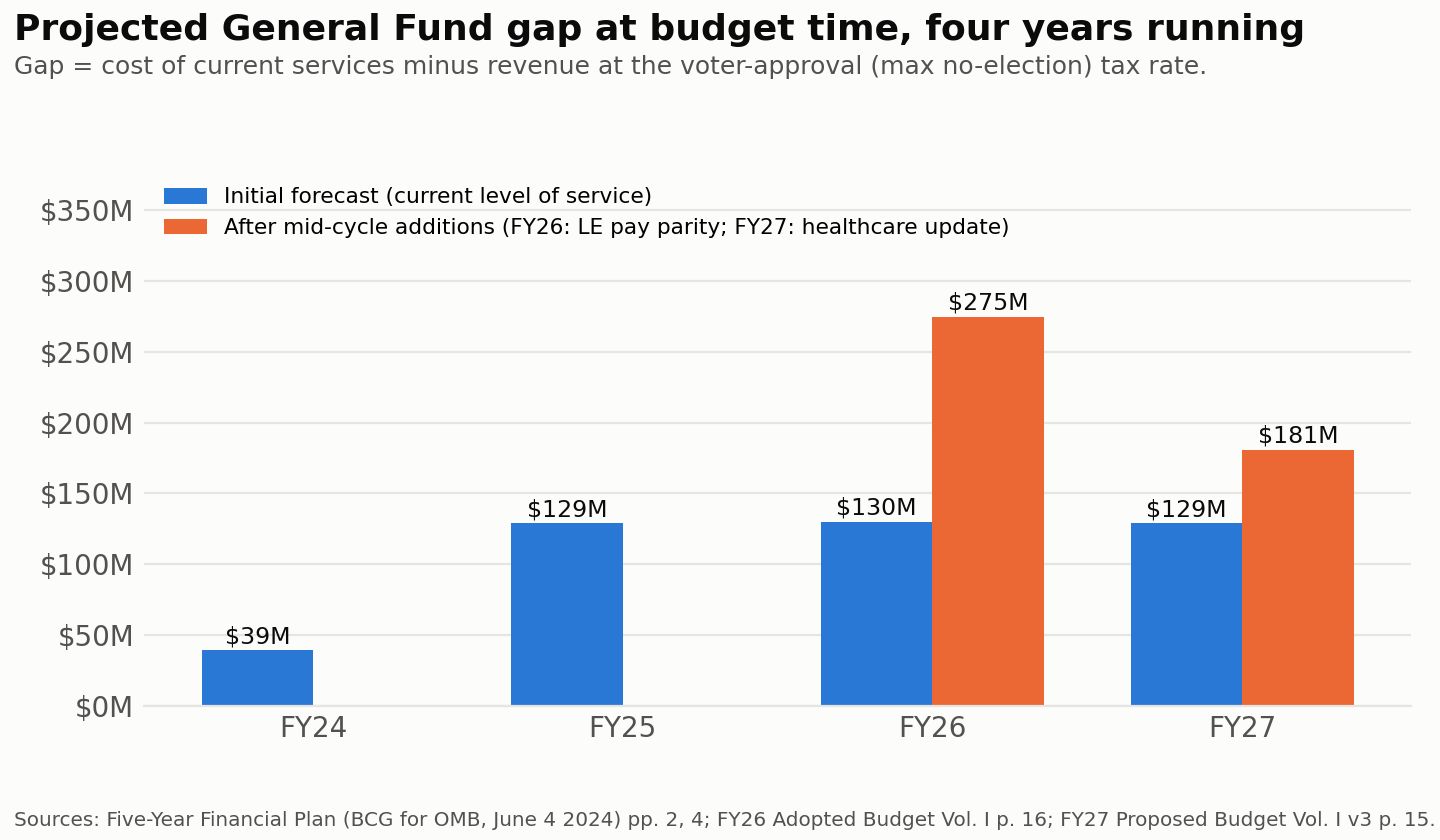
Figure 3. The projected gap at budget time each year. The FY26 jump is the law-enforcement pay-parity commitment ($142M in year one); the FY27 jump is a $51M healthcare re-estimate in July 2026.
The structural problem. The county's Five-Year Financial Plan (prepared by BCG for OMB, June 2024) found that General Fund expenses grew about 6% a year over ten years and 7% over five, against revenue growth of 4.5-5%, and that on the "glidepath" scenario the fund balance would turn negative by FY29 (-$580M). The FY25 and FY26 budgets then grew faster than the plan assumed. OMB's FY27 cost-to-continue estimate ("CLS/S") was $3,056M in May 2026 against $2,927M of revenue at the maximum no-election tax rate, a $129M gap; at the no-new-revenue rate the gap would have been $257M. In July the healthcare estimate rose $51M and jail-outsourcing savings fell $1M, making the gap $181M.
Why costs rose $327M in one year (FY27 budget vs FY26 budget). The county's own breakdowns:
| Driver (OMB, Aug. 17 2026 presentation and June 2026 town hall) | Amount | What it is |
|---|---|---|
| Employee healthcare | +$89M GF (+$100M all funds) | Self-insured plan for ~46,000 lives; 2025 medical trend 16%, pharmacy 13%; cost per employee $20,228 to $25,342 (+25%); Court declined to raise employee premiums or deductibles for 2027 |
| Law-enforcement pay parity, year 2 | +$76M (OMB, incl. supervisors and staffing); $44.6M in dept. lines | Second step of the May 2025 commitment to match HPD pay; Vol. II department lines: Sheriff $21.3M, constables $18.4M, DA $2.3M, Fire Marshal $2.1M, County Attorney $0.3M |
| Maintaining current service levels | +$61M | Inflation in facilities, fleet, utilities, software, cost-of-living factors; includes $14M of former ARPA programs |
| Restoring one-time FY26 savings | +$69.3M (Vol. II, General Administration) | FY26 was balanced with a $25M hiring freeze and $44M of special-revenue-fund transfers that do not recur |
| Funding vacant positions | +$30.8M | "Fund law enforcement at sustainable staffing" lines in nine law-enforcement departments (Vol. II department change tables) |
| Pay-equity study annualization | +$30M net ("Compensation Study Increases" line) | Compensation study adopted late 2025 ($73M/yr); $50M budgeted centrally in FY26; in FY27 $60.8M is distributed to department lines and the same $60.8M is removed from General Administration, which keeps a $21.4M pool |
| TIRZ payments and state mandates | +$30M | TIRZ payments $61.3M to $91.3M (largely offset by revenue); new courts, SB 9 bail changes |
| Indigent defense and jail | $184M proj. FY26; $15M more for Public Defender | Court-appointed attorney costs doubled in five years; PDO target 50% of cases; jail outsourcing $39.8M budgeted (down from $48.7M) |
Table 2. Sources: FY27 Vol. I v3 pp. 15-21, 75-76; FY27 Budget Town Hall slides (OMB, June 2026); Community Impact 8/2026 and 5/14/2026 (OMB presentations); Vol. II department-level change tables (data/vol2_change_items_aggregated.csv, revision 2). OMB's categories overlap and are not additive.
| Named change in the 81 department change tables (Vol. II) | $M |
|---|---|
| Group Health Increase lines | +81.5 |
| Year 2 - Law Enforcement Pay Parity Plan lines | +44.6 |
| Fund law enforcement at sustainable staffing | +30.8 |
| Compensation Study Increases, net of pay-equity transfers ($60.8M out of General Administration, $60.8M into departments) | +30.0 |
| One Time Savings and Special Fund Restoration | +69.3 |
| TIRZ increases and payments | +30.0 |
| Pension Adjustment lines | -8.0 |
| Contract patrol allocation to constables, net of the General Administration reduction | 0.0 |
| All other changes, net (about 600 lines) | +47.9 |
| Total = Appendix A increase | +326.0 |
Table 2b. An additive reconciliation of the $326.0M departmental increase from the department-level change tables in Vol. II (83 tables, each reconciling opening budget plus changes to closing budget; the 81 General Fund departments tie to Appendix A to the dollar). Group health here is the sum of the named department lines; OMB's narrative uses $89M General Fund and $100M all funds and the book does not bridge the two. Revision 2: the first edition summed program-level tables together with department tables and overstated group health ($156.5M) and staffing ($44.7M).
Revenue side. Taxable value rose only 0.8% (certified estimate $695B); existing-property value fell about 1%. FY26 revenue grew just 2.3% after the FY24-FY25 surge (+10.2%, +11.0%), which came from applying accumulated unused increment in FY24 and the disaster-exception tax rate in FY25 (0.35007 to 0.38529 after the derecho and Hurricane Beryl). Property tax is about 80% of General Fund revenue; the state's 3.5% cap therefore holds revenue growth near 4-5% in a normal year while recurring costs grow faster.
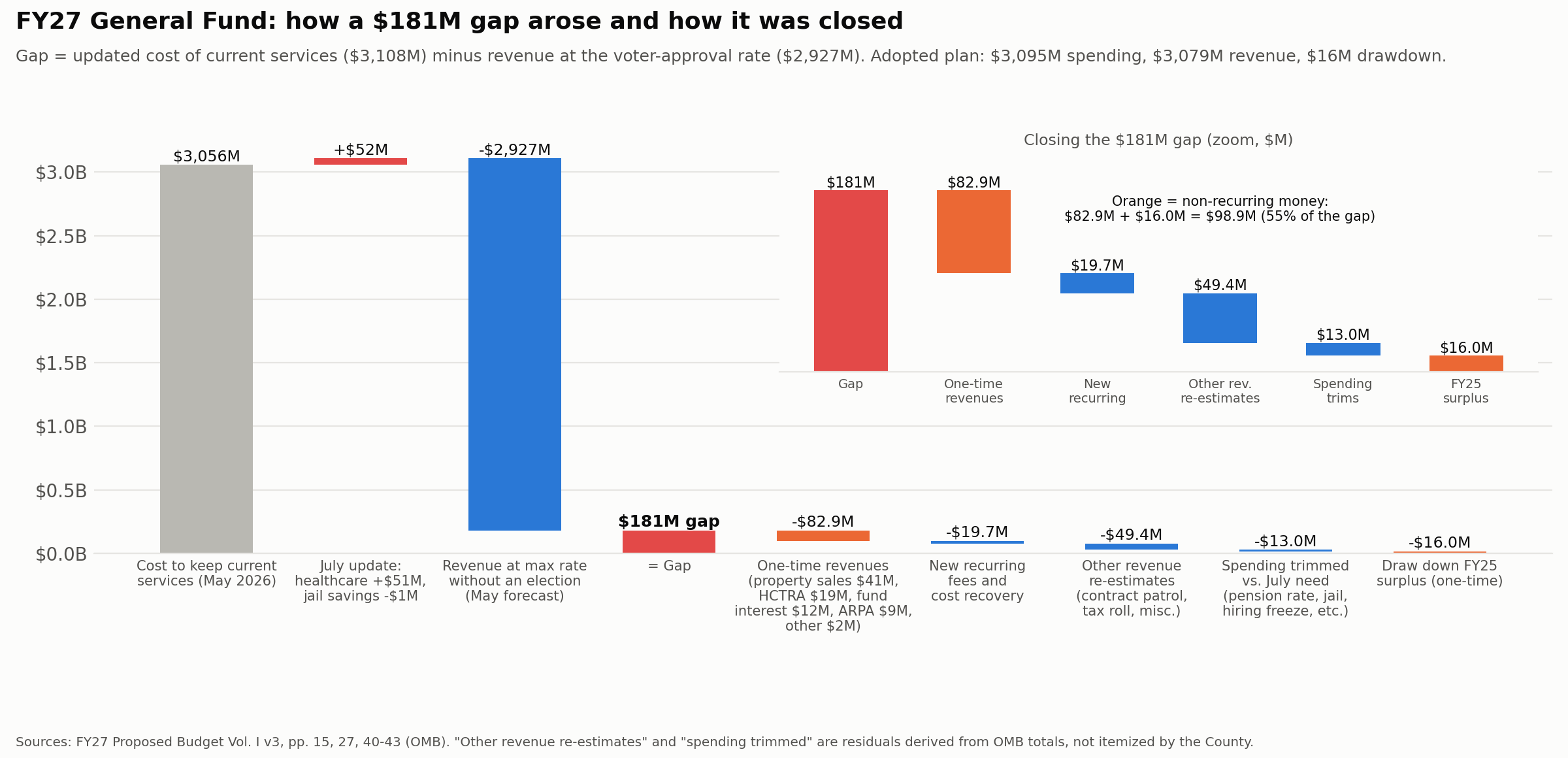
Figure 4. How the $181M gap arose and how it was closed. Orange = non-recurring money. "Other revenue re-estimates" ($49.4M) and "spending trimmed" ($13.0M) are residuals: OMB publishes the totals but not an itemized reconciliation. The tax-rate assumption (about $128M vs the no-new-revenue rate in OMB's May scenarios) is already inside the $181M.
Dependence on one-time money. The adopted budget balances $3,095M of spending against $3,079M of revenue plus a $16M surplus drawdown. Within the revenue, OMB itemizes $82.9M of "new, one-time revenues ... for which a replacement funding source will be needed in subsequent years." The county also assumed the maximum tax rate for every year of its five-year forecast (M&O revenue +5.5% a year through FY31). Judge Hidalgo's office states the county carries $118M of commitments without identified funding in FY26, $179M in FY27 and $285.8M a year from 2029 as the law-enforcement raises phase in; the Baker Institute's independent review puts the fully phased-in cost of the raises at roughly $200M of added payroll.